Key Summary
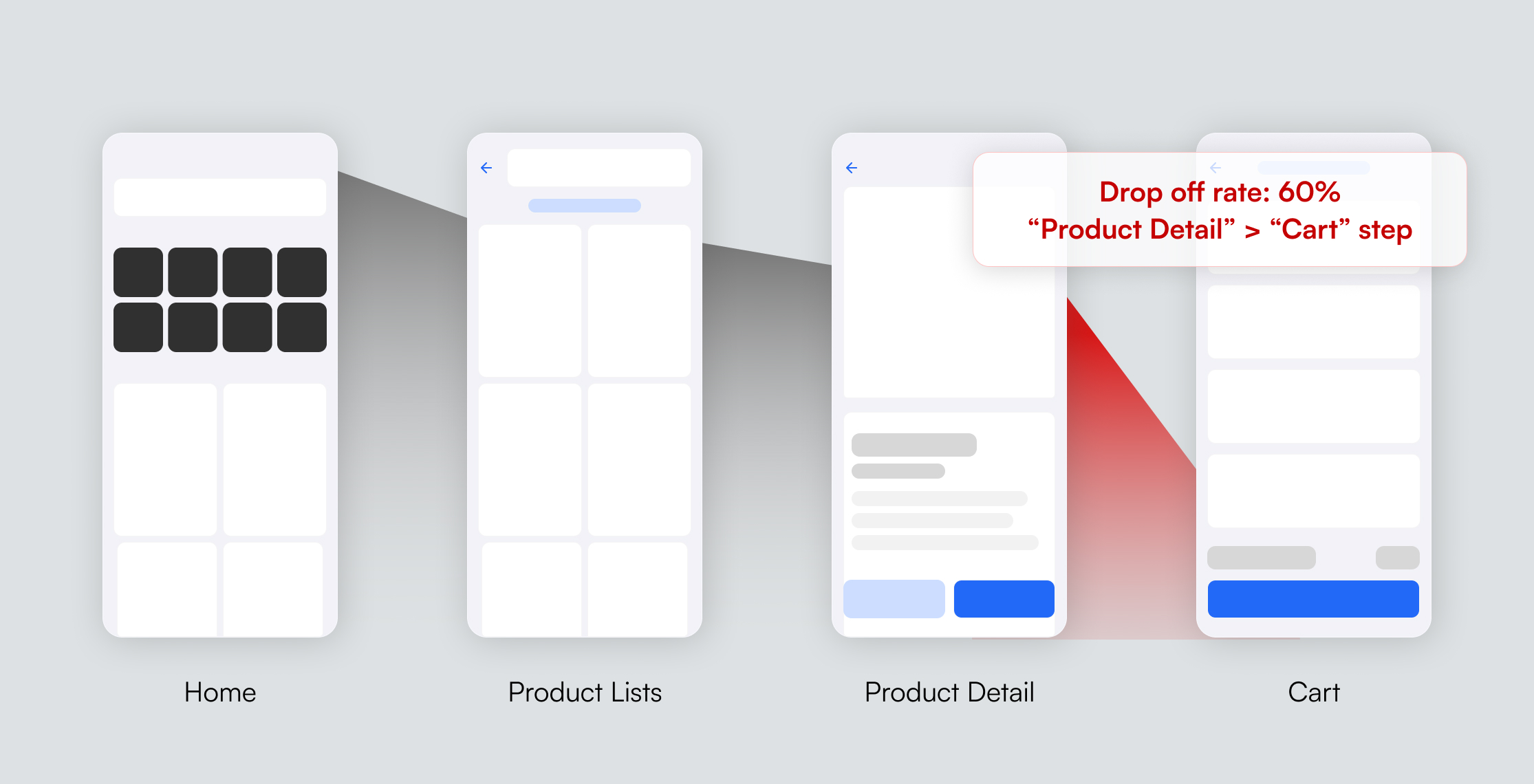
Our team found a major drop-off rate at 60% at the step “Product Detail” to “Cart”, but the data alone couldn’t explain why.
The root causes behind the drop-off was unclear. Without understanding what was really happening to the users, it was difficult to make confident product decisions of how to solve this problem.
Strategic Approach
I led a mixed-method research approach, combining behavioral data analysis with qualitative research (user interviews and usability testing).

By connecting “what” users were doing with “why” they were doing it, we uncovered key friction points and unmet needs that weren’t visible in dashboards alone. I translated these insights into clear, prioritized recommendations for the product team.
Business Impact
The research helped the team move from assumptions to evidence-based decisions. It clarified where growth was being blocked and gave both design and business stakeholders greater confidence in the next steps.
This helped realigning product priorities, allowing the team to focus on high-value features that solve core friction and drive product growth.

Research showed that the current app design failed to accommodate the drop-off users to easily understand benefits of using the platform as the loyal customers have known.
How might we make it simpler for users to discover and take full advantage of the key benefits the platform offers?
Platform’s Key Benefits: Free shipping when pick up at stores, Authentic products, Some products are actually cheaper compared to other shopping platforms
Key Takeaway
This study uncovered friction points that prevented users from completing purchases, these issues that may have gone unnoticed without funnel analysis. By combining behavioral data with research, we were able to proactively identify improvement areas and give the team a clear starting point for action.
Beyond traditional triggers like customer feedback or NPS, data analytics can serve as an entry point for product improvement. When pairing design-data strategy and ongoing monitoring, this practice becomes a continuous driver for product growth.
Full Case Study
Still curious about this project? Use this section below to see my complete end-to-end thinking process
Project Background
From the funnel analysis, we found a major drop-off rate at 60% at the step “Product Detail” > “Cart”. Moreover, 99% of the people who’ve left the product detail page, have never purchased anything on this platform at all (79% of them already have a membership with our client’s platform)

We want to discover reasons why these potential customers are leaving the platform at the “Product Detail” page. “What are the current issues that they are facing?” and “How can we minimize those frictions so that they would be likely to purchase our products?”
Hypotheses are developed as a starting point to guide the research path to be effective.
Why do this user group of users decide to leave this application?
- “They might not know that there’s a free pick-up option when pick-up at store.”
- “They might not know that there are special discounts for users with membership.”
To discover the reasons behind this drop-off, our team came up with a plan to conduct exploratory research, collecting user insights and feedbacks to identify user pain points and areas of improvement.
Research objectives are formed to identify exactly what we want to find out and to frame the direction of the research methodologies.
1. Uncover insights from both side of our extreme users: Drop-off users and Loyal users, to identify the gaps between user needs and their current experience
Note: Loyal users are users who frequently use and make purchases through our platform. As such, they may have some tips to help them achieve their goals that could be unknown to the drop-off users.
2. Gather current usability issues on the current design to identify friction points
The insights gathered from this user research will help us get a clear understanding of our user journeys and help us identify friction points and come up with ideas to improve the platform.
Overview Research Process

Align
Align data findings with client’s business goal to create a research proposal for pitching

Plan
Recruit research participants and create a research protocol

Gather
Capture data by conducting in-depth Interviews and usability Testings

Analyze
Summarize data and moderate an ideation workshop

Apply
Develop deliverables: Present findings and recommendation to stakeholders

Align
In order to define the research plan that align with the product’s goal, it is necessary to align understandings with the data team and the project manager of this product.
Talking to the data team helped me understand the insights they were finding from the funnel analysis and set the objective of the study that we wanted to go for.
Meanwhile, talking to the PM (as a representative of the client side) ensured that what we were trying to find out would align with the business goal of our client. (In this case, the client's goal was to drive the conversion rates of the funnel - promote purchases on their platform.)
Research proposal is used to identify the goal of the research and explain a brief research process to our clients.
In this way, the client could understand the importance of this research project and how can they use the data after getting the research results.
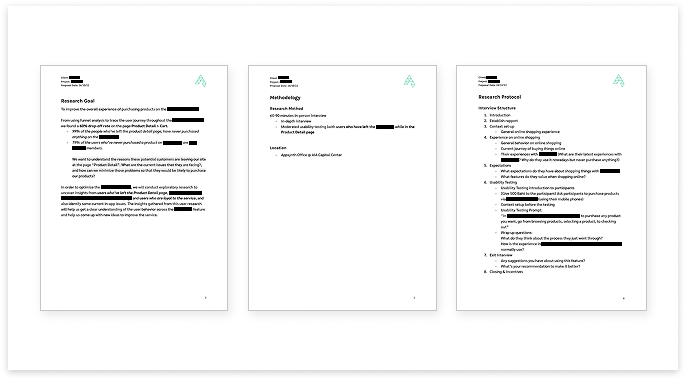
Example photo of the Research proposal
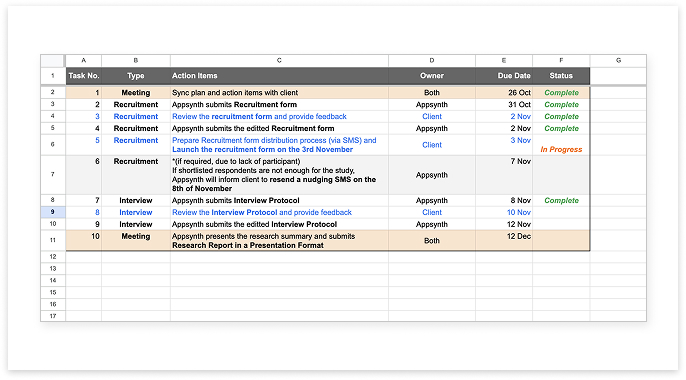
Timeline and Action Items Sheet is used to synchronize tasks between researcher and clients as the project requires client support on the recruitment process.

Plan
Participant Recruitment Process
As mentioned, there are 2 types of participant in this study: Drop-off users and Loyal users. The criteria for participant selection were carefully defined to ensure we would recruit the right participants for the study.
Note: To define a criteria for participant selection of the loyal user, we find that the average number of purchases per month - from users who have purchased things in this platform every month, in the past 3 month - is 1 times (once a month).

Loyal User
Behavior on the client’s platform
Made a purchase via this platform 1 time/month or more in the past 3 months
General online shopping behavior
Made a purchase through any e-commerce platforms 1 time/month in the past 3 months

Drop-off User
Behavior on the client’s platform
- Have dropped-off at the Product Detail page
- Never purchased anything from this platform
- Have visited this platform in the past 30 days
General online shopping behavior
Made a purchase through any e-commerce platforms 1 time/month in the past 3 months
Apart from defining the criteria of participant direction, one of my main task in the recruitment process is creating a recruitment form, selecting eligible participants, and contacting them.
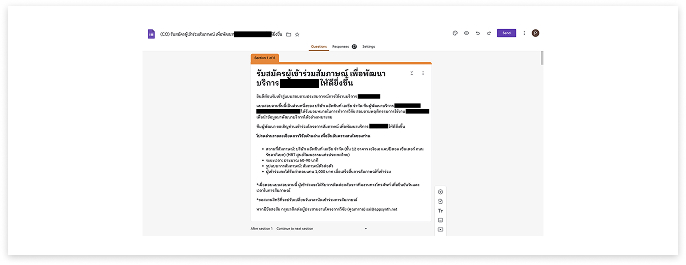
Recruitment Form
The recruitment form is used as the tool for participants to sign up for the study.

Participant Criteria Sheet
Data team used this information to filter and prepare participant ID lists that match with the criteria.

Gather
To discover user motivation towards online shopping and area of improvement within the application, we’ve conducted exploratory research with these 2 research methodologies.
1. Online In-depth Interview
To find out motivations, user gain and pain points on purchasing items via our client’s application and other online shopping apps.
2. Board Usability Testing
To gather usability issues (With Drop-off users), participants were ask to think aloud while using the application, UXR and note-takers took note when the participants got stuck, showed confusion or frustration.
Note: Board usability testing tasks allows the participants to complete the tasks with their own ways. This allows us to capture insights without biases from influencing users with too specific tasks.
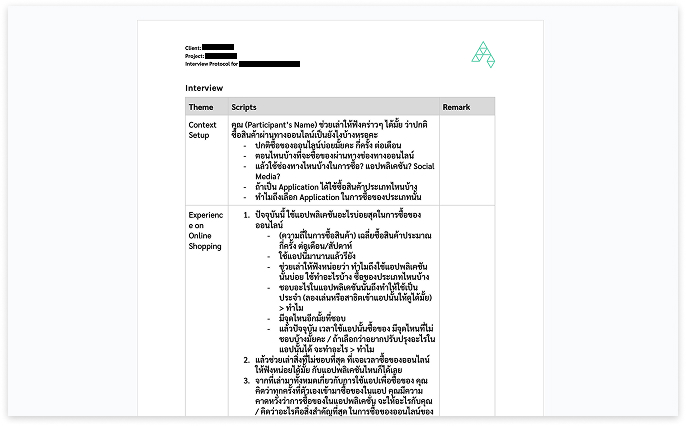
Research protocol was planned before the interview day to ensure the interview session will be well-planned and systematic.
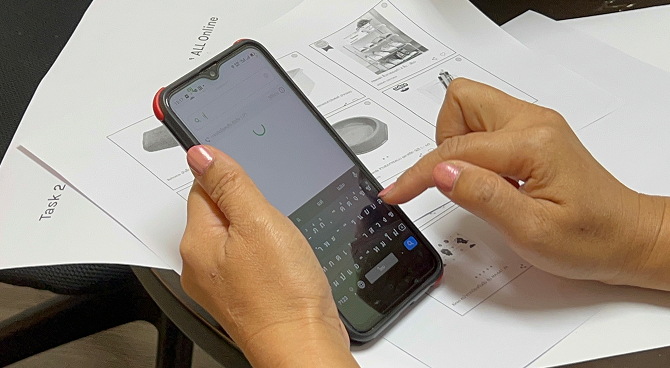
Interview Session: A participant was performing a task from Usability Test.

Analyze
Key Research Findings
Participants that we’ve conducted a research with are the type of consumers who routinely purchase everyday products through online platforms on a regular basis - when purchasing a product online, this type of user has a habit of switching between different online shopping applications in order to find a seller that offer them the most cost-effective prices (after applying all discount codes and shipping fee)
Even though users try to find the seller that offer the cheapest final price, they tend to select the platforms / sellers that offer authentic and standard quality products.
These 2 user groups share the same goal of “Finding the most cost-effective prices on the client’s platform”. However, the Loyal users have a knowledge to find the most cost-effective prices while the Drop-off users are unaware of the strategies to find one.
Usability Issues
Usability issues that we found during the test also explain why the Drop-off users could not find the best deal on this platform.
Overall, it can be seen that the current app design failed to accommodate the drop-off users to easily understand benefits of using the platform offers as the loyal customers have known.
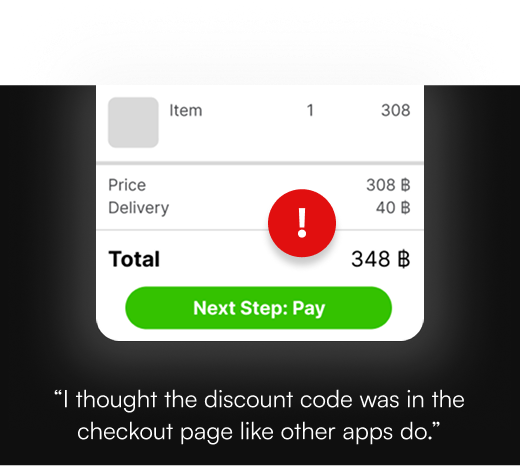
Difficulty in finding discount codes
Drop-off users found it difficulty to find promotional codes (show frustration, and confusion), some of them couldn’t complete the task
Lack of find-ability of the “Free Shipping” benefit
This platform offers a free shipping option if users choose pick up at store option, however the checkout page always displays the fee of the delivery service and doesn’t clearly show on the screen that there is a free shipping option available.
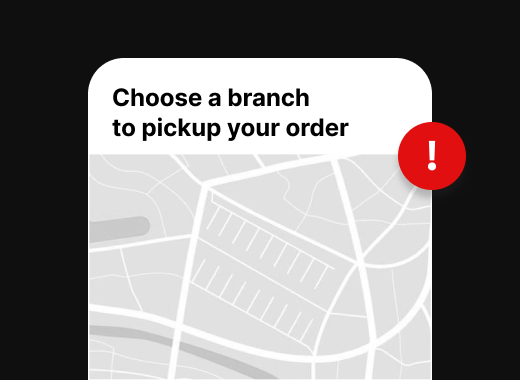
Cumbersomeness on using Free Shipping
Participants found it hard to choose a store branch that they wanted to pick up the order (Free shipping option)
Research insights have been shared with the team, we developed “How Might We” statements to guide the design improvements.
How might we make it simpler for users to discover and take full advantage of the key benefits the platform offers?
Platform’s Key Benefits: Free shipping when pick up at stores, Authentic products, Some products are actually cheaper compared to other shopping platforms
After analyzing and synthesizing the research data, I had a chance to conduct an Ideation Workshop with the working team (project manager, data team, and designers).
The core objectives of this ideation workshop is letting everyone in the working team seeing the same picture of what the current issues in our service that the drop-off users have experienced are. Moreover, our team get a chance to brainstorm potential solutions to improve the platform.
Workshop Preparation
As a facilitator of the ideation workshop, it is important to prepare the session materials well in advance. Doing so will help ensure a smooth and effective facilitation process, allowing the session to run productively.
Workshop Materials include:
- A quick-read report for our working team to read individually before the session (To understand the objectives of the ideation session and understand the background of the study)
- Research insights and “How Might We” statement
- Other material for brainstorming such as post-it, images related to the application for our stakeholder to use during the process.
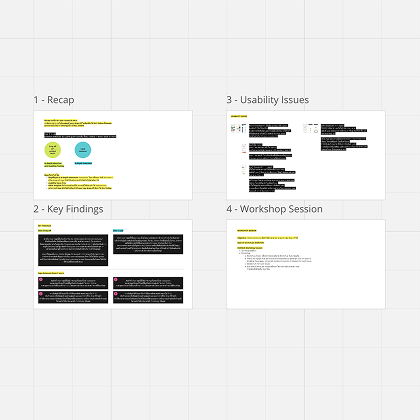
Quick-read Report
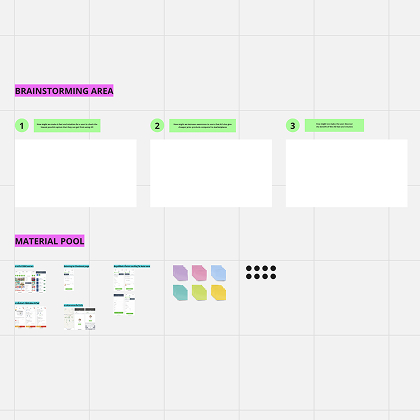
Workshop Material Preparation

Apply
A lot of interesting concepts to improve the app have been suggested during the ideation workshop, we have selected the concepts that our team has agreed upon, and developed them into final recommendations.

Make it fast and intuitive to discover the lowest possible option that they can get from using the app

Increase awareness that the app also offer the cheapest items comparing to other shopping apps

Increase awareness of “Free Shipping” option and make the feature become more easier to use
Research finding and design recommendations are delivered to our clients in a slide presentation format.
For final deliverable, I and my team had a session to present the insights we found, the session allows us to share user insights, helping clients understand user experiences and design solutions to minimize pain points.
Research Impact
Design Team
The insights provide designers with a clear understanding of user expectations, helping them to make informed decisions about design and feature development.
The insights help designers prioritize features and improvements, ensuring the design aligns with user needs and delivers meaningful designs.
Product Team
The funnel analysis provided a proactive foundation for identifying and addressing potential problems, enabling the clients to pinpoint areas for improvement.
The insights allow the product manager to understand users' current pain points, prioritize effectively, and make informed decisions for future development.
Business
Redesigning the user flow to be more simplified and to be able to clearly communicate the product's value proposition will help users reach the final, lowest price faster. This, in turn, will help enhancing the efficiency of the sales funnel as well.